
An Ode to Scrubs
Or: How I Learned to Stop Wondering and Relate to Dr. Cox

Remember DVDs? Those plastic discs we’d stack beside the television, each one a small commitment to story and time. This was before streaming platforms knew our viewing habits better than we knew ourselves. Before “Continue Watching” followed us from device to device like a dutiful but slightly judgmental companion. Before we could pull up any episode, any moment, any musical montage scored to The Fray within seconds.
We had to wait. We had to choose. We had to sit through the credits.
The news that Scrubs is coming back feels like finding something I didn’t know I’d lost. Not the show itself—I could rewatch it anytime—but the version of myself who first watched it. It’s formative television for those of us who came of age in medicine during the 2000s, born in the 80s and 90s, raised on equal parts Grey’s Anatomy drama and Scrubs’ peculiar alchemy of slapstick and sincerity, fart jokes and philosophy, absurdist humor and devastating grief.
But where Grey’s Anatomy gave us the fantasy—brilliant surgeons in pristine makeup saving lives between romantic entanglements—Scrubs gave us something closer to the truth. It understood that hospital fluorescent lighting is unflattering. That you’ll spend more time on documentation than with patients. That the sacred heart of medicine beats beneath layers of bureaucracy and exhaustion and dark humor deployed as self-defense.
The Characters We Became

For those who didn’t grow up with Scrubs, let me introduce you to the inhabitants of Sacred Heart Hospital. JD—that’s John Dorian, our protagonist—is the earnest, optimistic intern who narrates most episodes through streams of consciousness and elaborate daydream sequences. He’s the idealist, the one who believes caring enough will be enough, who forms deep emotional connections with patients and takes every death personally. Most people who loved Scrubs identified with JD. He was the everyman, the viewer surrogate, the one who made medicine look like a calling rather than a job.
I wasn’t JD. I wish I had been.

I was Elliot Reid—the anxious, Type-A girl who approached medicine like a series of tests she could ace through sheer force of perfectionism. Elliot, who would spiral into anxiety over every mistake, who needed to prove herself constantly, who measured her worth in achievements and feared failure more than anything. Elliot, who was simultaneously deeply competent and convinced she was failing at everything.
That was me watching on those DVDs. Anxious, perfectionistic, certain that one mistake would reveal me as the fraud I secretly feared I was.
But here’s the thing about Scrubs and time and medicine: you don’t just identify with one character forever. The show was brilliant enough to give us a whole spectrum of coping mechanisms, and as you move through your career, you find yourself sliding between them.
Because now? Now I’m also Dr. Perry Cox.
The Cox Conundrum
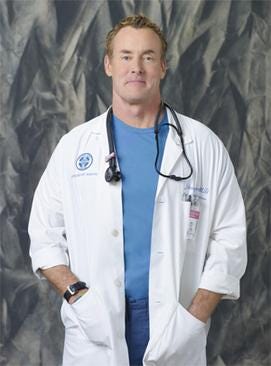
For the uninitiated, Dr. Cox is the senior attending who serves as JD’s reluctant mentor. He’s brilliant, sarcastic, angry—a man who delivers devastating monologues about the failures of medicine, healthcare bureaucracy, and human stupidity in general. He gives his interns girls’ names (JD is variously “Newbie,” “Sally,” “Jennifer”), rails against hospital administration, and seems to run on pure contempt and whiskey. He’s the cynic to JD’s optimist, the realist to everyone else’s idealism.
I used to wonder how Dr. Cox became so angry. So bitter. So quick to rage at incompetence and inefficiency and the endless, grinding bureaucracy of healthcare. His cynicism seemed performative, a character trait written for comedy and contrast. Watch him eviscerate a medical student’s confidence in thirty seconds flat. Watch him mock sincerity, dismiss sentiment, reduce human connection to weakness.
When I was Elliot, I thought: I will never become that. I will never let this job harden me that way. I’ll stay anxious and careful and caring. I’ll maintain my standards. I’ll keep trying to be perfect.
What arrogance. What beautiful, necessary, temporary arrogance.
Here’s what they don’t tell you in medical school: medicine doesn’t just reward the Dr. Coxes of the world. It creates them. Not through any single moment. There’s no before-and-after, no clean break between idealism and exhaustion, no precise moment when you become the person you swore you wouldn’t be.
It’s cumulative.
Patient after patient who doesn’t take their medications, then returns sicker, then looks at you like their deterioration is your failure. System after system that punishes efficiency and rewards documentation, that measures quality in clicks rather than care. Meeting after meeting about meetings about initiatives about outcomes about metrics that bear increasingly distant relationship to actual patient wellbeing.
The gap between what you know you should do and what the infrastructure allows you to do, widening with each passing year. Until one day you hear yourself talking to a junior colleague and you sound exactly like Dr. Cox. Dismissive. Exhausted. Performing cynicism to protect the small flame of caring that remains.
The Elliot anxiety is still there—I still agonize over every decision, still measure myself against impossible standards. But now it’s wrapped in Cox armor. The anxiety became anger. The perfectionism became rage at systems that make perfection impossible.
Grief Disguised as Rage
I think about Dr. Cox differently now. The anger wasn’t pathology—it was grief. Grief for every patient lost to failures of the system rather than failures of medicine. Grief for the doctor he thought he’d be, the one who could save everyone if he just worked hard enough, cared enough, stayed long enough. Grief disguised as rage because rage is easier to metabolize than sadness when you still have twelve hours left in your shift and three more patients waiting and the EMR just crashed again.
If you’ve never watched Scrubs, you need to watch the episode “My Screw Up.” It’s the one where Dr. Cox’s best friend Ben—a photographer, a goofball, the guy who makes him laugh—comes to the hospital for the weekend. Ben’s son is having a birthday party and we spend the episode watching them goof around, take photos, reminisce. Dr. Cox seems almost happy. Almost human.
And then at the end, JD asks him where he’s going. He’s going to a funeral, Cox says. He’s been at a funeral this whole time. “Where do you think we are?”
Ben is dead. Has been dead the whole episode. Everything we’ve watched has been Dr. Cox’s denial, his inability to process that he couldn’t save his friend. The camera pulls back and we see we’re at a cemetery. The jazz music cuts out. And Dr. Cox, who is never vulnerable, who armor-plates every emotion in sarcasm, completely breaks.
The show knew. It knew that beneath the sarcasm and the rants and the whiskey-soaked cynicism was someone who cared so much it hurt. Someone who chose anger because the alternative was drowning.

That’s the secret of Scrubs that I’m only now understanding: everyone on that show was coping. They just chose different mechanisms. Dr. Cox chose rage. JD chose fantasy and daydreams. Turk—the surgeon, JD’s best friend, played with easy confidence by Donald Faison—chose compartmentalization, keeping work and life separate. Carla, the take-no-prisoners nurse who eventually marries Turk, chose control and maternal bossiness. Elliot chose anxiety and people-pleasing. Dr. Kelso, the seemingly cruel chief of medicine, chose pragmatic cruelty that turned out to be pragmatic protection against caring too much in an impossible job.
None of them were wrong. They were surviving.
Different Characters, Same Show
Most people who went into medicine probably saw themselves in JD. He’s the obvious identification—the protagonist, the idealist, the one who makes medicine look noble and meaningful despite its flaws. He’s who we want to be: emotionally available, deeply caring, capable of vulnerability, finding meaning in suffering.
But I suspect if we’re honest, many of us have slid across the character spectrum over the years. Started as JD or Elliot, ended up somewhere between Cox and Kelso. Kept the anxiety, added the anger. Maintained the caring, wrapped it in cynicism for protection.
I wonder sometimes if I’ll rewatch Scrubs and see myself in yet different characters now. Will I finally understand Dr. Kelso’s exhausted pragmatism about what’s actually possible within broken systems? The way he had to make impossible decisions about resources, knowing that every choice meant someone suffered? Will I relate to Jordan—Dr. Cox’s ex-wife who never quite stays ex—and her absolute refusal to pretend any of this is fine, her insistence on naming the dysfunction rather than metabolizing it silently?
Will I finally understand the Janitor’s antagonism as philosophy? His commitment to absurdity in a place that demands we pretend everything makes sense? His recognition that if you’re going to be stuck in a building where people suffer and die, you might as well make it weird?
The show knew something we didn’t yet know: that everyone in medicine is coping, we just choose different mechanisms. And it had the courage to show us that there’s no right way to cope, no moral high ground in the architecture of survival. Some of us become Dr. Cox. Some of us stay JD. Most of us—if we’re honest—cycle through different characters depending on the day, the patient, how much sleep we got, whether we remembered to eat.
Why Scrubs Endures
Maybe that’s why Scrubs endures when other medical shows feel dated. It never pretended healthcare was noble. It showed us people trying to be good in a system that makes goodness complicated. People who chose dark humor over despair, friendship over isolation, keeping going over giving up.
It understood the moral complexity of medicine in ways that procedurals couldn’t touch. Yes, you save lives. You also make mistakes. You participate in systems that harm. You try your best and it’s not enough and you come back tomorrow and try again anyway. You care deeply and you learn to care less because caring at full intensity is unsustainable, and then you hate yourself for the caring less, and then you make peace with it, and then you don’t.
The show gave us permission to be messy. To fail. To be petty and tired and human while wearing the white coat that demands we be something more. It showed us that you could be a good doctor and a flawed person, that those things aren’t contradictory but complementary, that maybe the people who do this work best are the ones who never fully resolve the contradiction.
The Price of Caring
The show understood what we’re only now beginning to say aloud in physician wellness conferences and burnout literature: that medicine extracts a price. That caring professionally means learning to care less personally, or you’ll shatter. That the people who seem most hardened are often the ones who felt things most deeply and found that feeling everything was unsustainable.
Dr. Cox teaches us this in every episode. Watch him mock JD’s sentimentality, then stay up all night researching a rare diagnosis. Watch him rant about incompetence, then fight like hell for a patient everyone else has given up on. Watch him pretend not to care, then break when his patient dies—or when Ben dies, when he finally can’t maintain the protective anger anymore.
The anger is the scar tissue. It’s what forms when you care too much, too often, and the world doesn’t care back. It’s protection. It’s survival. It’s the price of staying in the arena.
And the anxiety—Elliot’s constant anxiety—is the other side of the same coin. It’s what happens when you know exactly how much can go wrong, when you’ve seen every possible complication, when you measure yourself against perfection and find yourself wanting every single time. The anxiety says: if I just try harder, control more variables, prepare more thoroughly, maybe I can prevent the bad outcome. The anger says: I tried all that and it didn’t matter.
They’re both grief. Just different dialects.
What Scrubs Gave Us
That’s what Scrubs gave us, really. Permission to be human in a profession that demands we be superhuman. Permission to fail and try again. Permission to be broken and keep going anyway. Permission to laugh at fart jokes while holding space for grief, to make fun of death because the alternative is being crushed by it.
The show knew that medicine is absurd. That we’ll remember the patient’s name but forget our partner’s birthday. It knew that survival in medicine requires contradiction. You have to care and not care. You have to try and accept that trying isn’t enough. You have to show up knowing you’ll fail someone today and show up anyway. You have to be anxious enough to catch every detail and angry enough to keep functioning when you miss one anyway.
Coming Full Circle
I’m grateful Scrubs is coming back. Not because I need more medical television—God knows we’re drowning in medical dramas that understand nothing about medicine (aside from maybe the Pitt: read our review here). But because I need to know what happened to these characters who once reflected who I was and now reflect who I’ve become.
Did JD keep his optimism, or did he finally understand why Dr. Cox stopped learning his medical students’ names? Did Dr. Cox ever find peace, or did he keep showing up, day after day, because what else do you do when you’ve given your life to something that will never love you back? Did Turk and Carla figure out how to maintain a marriage when medicine demands everything? Did Elliot stop seeking approval from people who would never give it, or did she just get better at hiding the need?
Did any of them figure out how to do this job without becoming someone they didn’t recognize in the mirror?
Or maybe I just want permission. Permission to acknowledge that medicine changed me. That the angry, exhausted parts aren’t failure but adaptation. That you can love this work and resent it. That you can be grateful for the privilege and devastated by the cost. That you can be both Elliot and Cox, both anxious and angry, both caring and hardened.
That all of these things can be true simultaneously.
Watching Again
I’ll watch the new episodes on whatever streaming service claims them, no DVDs required. No waiting between discs, no commitment to finish what I started. I can pause anytime, scroll to something else, let the algorithm decide what I need.
But I’ll think about that younger version of myself, watching on a small screen in a small room, probably when I should have been sleeping or studying. II think she’d understand why I relate to Dr. Cox now. Why the anger makes sense. Why Elliot’s anxiety metastasized into Cox’s rage. Why caring less is sometimes caring better. Why showing up exhausted is still showing up.
I think she’d forgive me for becoming someone who’s both of them—anxious and angry, perfectionistic and cynical, still caring but wrapped in armor.
And maybe—this is what I hope from the new episodes—I’ll find that Dr. Cox found something too. Not peace, exactly. Medicine doesn’t give us peace. But maybe equilibrium. Maybe the understanding that you can be angry and still be good. That you can grieve what this work costs and still choose it. That you can become someone you didn’t expect to be and still recognize yourself.
That would be the perfect ending for Scrubs. Not redemption or resolution, but recognition. The acknowledgment that we’re all just people in scrubs, trying our best, choosing different ways to cope, showing up anyway.
Victoria Ekstrom is a narrative medicine advocate who’s constantly seeking the balance between compassion and professional distance. When she’s not writing or pondering empathy’s role in medicine, she’s chasing after her two kids, her dachshund, and—occasionally—new inspirations from unexpected places (like TV ads).