

When Pain Becomes Protocol: A Lesson in Sacred Touch
A collaborative reflection by Dr. Jason Chang and Dr. Victoria Ekstrom

Authors’ Note: What follows emerged from a profound clinical encounter and a shared conviction about the future of medical education. When Jason cared for *Theodore (Patient’s name and identifying details have been changed to preserve privacy and confidentiality), a teacher admitted to our Intensive Care Unit, the conversation that unfolded challenged everything we thought we knew about clinical examination. This piece represents our joint effort to honor his teaching and to advocate for a fundamental rethinking of how we touch our patients. — Jason & Victoria
Thedore laid in the Intensive Care Unit, his body failing him in multiple ways: end-stage heart disease, liver disease, kidney disease, and now an acute intracranial hemorrhage. His consciousness ebbed and flowed like a tide. Some moments he was unreachable, eyes closed, silent. Other moments he surfaced, speaking with startling clarity, his mind sharp even as his body betrayed him.
It was during one of these lucid moments that Theodore spoke words that would fundamentally change how we think about our work.
“I feel traumatized,” he said, his voice steady despite everything, “by the numerous doctors who press on my limbs and fingers so hard when they come to examine me. It causes me so much pain. Is it necessary? I have PTSD from all the clinical examinations.”
We Tell Ourselves the Pain Is Necessary
In medicine, we have learned to justify the pain we inflict. We tell ourselves it is medically necessary—that the sternal rub, the nailbed pressure, the manipulation of inflamed joints are required to gather clinical data, to assess responsiveness, to document neurological function. We frame it as part of our duty: good doctors are thorough, and thoroughness sometimes requires discomfort. We document our findings—“responds to painful stimuli”—and move on to the next task, rarely pausing to consider what it feels like to be on the receiving end of that “stimulus.”
But Theodore challenged that justification with devastating simplicity. “When my wife wants me to wriggle my toes, she gently rubs my feet, and I can wriggle them for her. When my father asks me a question, he holds my hand softly, and I squeeze back to let him know I agree.”
His family had discovered what we, in our clinical protocols, had forgotten: gentleness can elicit the same clinical information as force. The difference is not in the data obtained but in the humanity preserved or violated in the obtaining.
Every Act of Examination Is Sacred
We have both been reflecting deeply on the role of touch in medical practice, and Theodore’s words crystallized insights that research has been revealing for years: one hundred percent of patients want appropriate touch from their healthcare providers. Not rough touch. Not rushed touch. Not touch that treats them as objects to be assessed. But touch that recognizes the sacred act of entering another person’s physical space, of laying hands on vulnerable bodies.
Every time we touch a patient, we are participating in something ancient and profound. We are entering into what researchers call an embodied “waltz”—a cocreated interaction where communication happens through touch itself, not just through the clinical findings we extract. Touch is never purely instrumental, never “just an examination.” It always communicates something: our care or our hurry, our presence or our distraction, our respect for the person or our focus on the task.
Theodore understood this instinctively. “The doctors and nurses here are wonderful,” he told Jason, “but they are always in a rush and focused on the task of assessing my conscious level. They don’t take the time to consider what it feels like to be the patient.”
The Fragile Boundary Between Care and Control
What struck us both most was what Theodore said next, drawing a parallel from his own profession: “As a teacher, I encounter the same in my work. There are teachers who see students as numbers—numerators and denominators—and do not focus on the individual student as a person.”
He had identified something essential about how systems can dehumanize even as individuals within them mean well. When we reduce patients to Glasgow Coma Scores to be documented, to responses to be checked off, to numbers on a chart, we lose sight of the person experiencing our examinations. And in that loss, there exists what touch researchers call “the fragile boundary between reassuring presence and control.”
The same hand pressed on a sternum can be experienced as necessary assessment or as assault. The difference lies not just in the force applied but in something more subtle: what researchers call “carefulness”—an ongoing attention to how touch is being received, a willingness to adjust based on what we perceive, a recognition that we cannot fully know another person’s experience and must remain open to learning through attention and feedback.
Theodore, even in his altered state, could feel the difference. He could sense when touch was performed with presence and when it was performed as protocol. His body carried the memory of each rough examination, accumulating into trauma he described as PTSD.
Still Teaching
“I didn’t imagine that I would be giving feedback on my own care in a hospital bed,” Theodore said.
Jason replied, “You are still teaching us today. That is your vocation. That is who you are—an educator at heart.”
And teach us he did. His story has forced us to reconsider everything we thought we knew about clinical examination. We justify the pain we cause as medically necessary, but how often have we stopped to ask: is it truly necessary, or have we simply accepted pain as part of the protocol? Could gentleness achieve the same clinical goals? When we assess response to pain, must we ourselves become the source of that pain, or could we learn from Theodore’s wife, who achieves assessment through tenderness?
The evidence suggests that touch matters profoundly. Meta-analytic research shows that appropriate touch produces therapeutic benefits comparable to pharmaceutical interventions—reducing pain, depression, and anxiety with effect sizes that would make any medication noteworthy. Yet we have somehow arrived at a place in medicine where touch is minimized, rushed, or performed with such anxiety about boundaries that we forget its healing potential.
A Call for Humane Touch
This encounter has inspired us to advocate for what we propose calling “The Humane Touch Initiative”—not as a new technique but as a return to something we have lost: the recognition that every examination is a sacred encounter, that every touch communicates, and that gentleness and thoroughness need not be opposed.
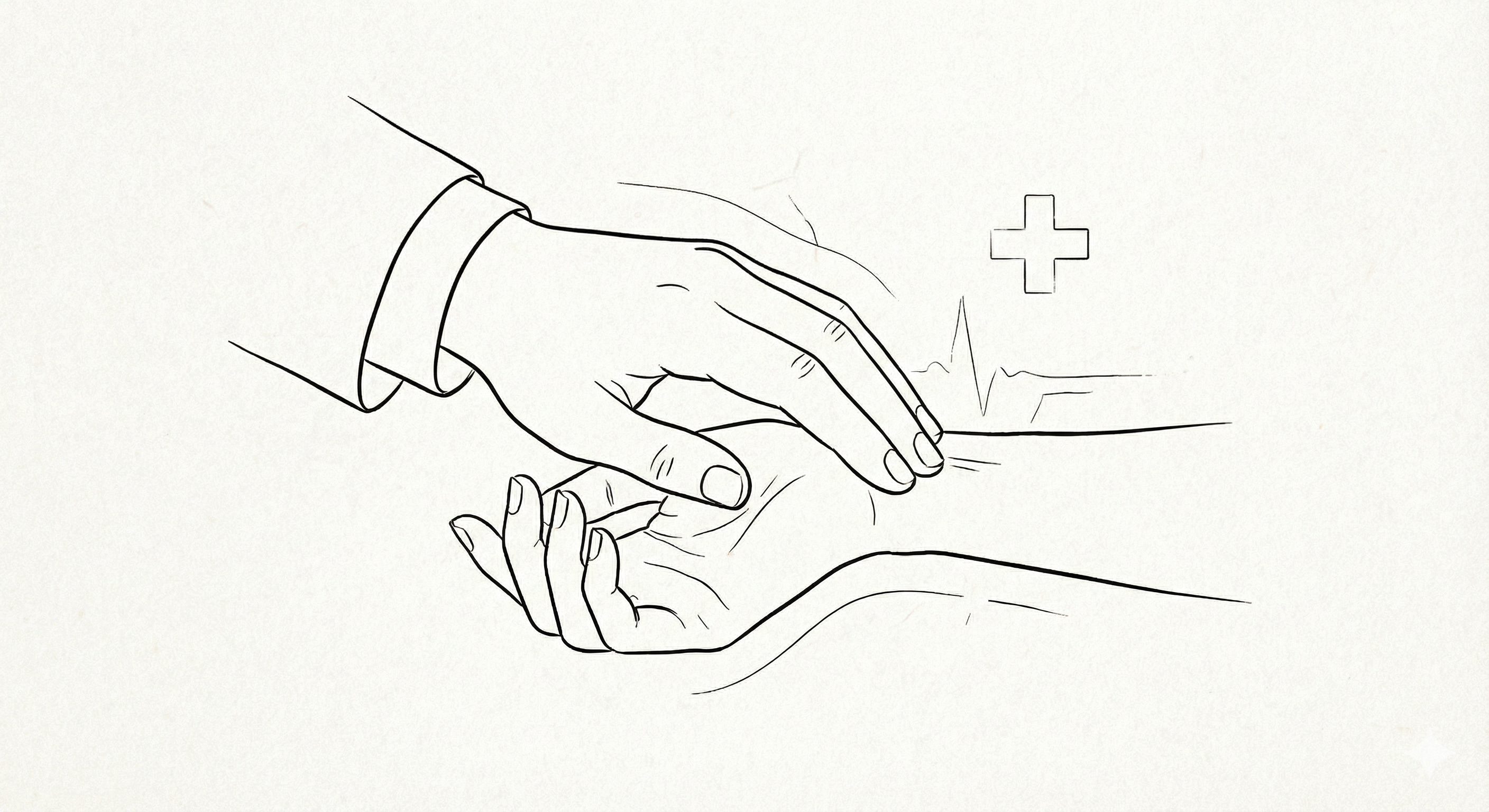
This initiative asks us to reconsider our most routine practices: When we assess response to pain in patients with altered mental status, must we press hard enough to leave bruises? Or could we, like Theodore’s wife, try gentle stimulation first and escalate only if truly necessary?
When we examine inflamed joints or tender areas, do we palpate with the assumption that some discomfort is inevitable? Or do we approach each examination as a dialogue, adjusting our touch based on subtle cues of the patient’s experience?
When we transfer patients or perform procedures, do we move efficiently through our task list? Or do we pause to consider the person experiencing our hands, our tools, our interventions?
The Humane Touch Initiative is not about avoiding necessary assessments. It is about bringing consciousness to how we perform them. It is about remembering that behind every Glasgow Coma Score is a person who may be listening, feeling, and forming memories—perhaps traumatic ones—of our touch. It is about recognizing that clinical competence includes not just gathering accurate data but gathering it in ways that preserve human dignity.
Teaching the Next Generation
Theodore’s lesson is simple but profound: in our focus on clinical necessity, we must never lose sight of our patients’ experience of that necessity. Every examination is not just a clinical act but a human encounter. The gentlest approach is often not only the most compassionate—it may also be the most effective.
Research confirms what Theodore discovered through suffering: patients can and do respond to gentle stimulation. The question we must ask ourselves is not whether we can justify the pain we cause as medically necessary, but whether we have truly explored alternatives before defaulting to force.
As we train the next generation of physicians, we commit to teaching them not just where to place their hands, but how to place them—with consciousness, with care, with recognition of the sacred trust patients place in us when they allow us to touch their vulnerable bodies. We commit to teaching them that every act of examination is a form of communication, and that the message we send through our touch matters as much as the clinical data we gather.
The authors invite feedback and collaboration from medical educators who share this vision of touch as sacred practice. Together, we can transform how the next generation learns to care for patients—one gentle examination at a time.